


29 October 2026

Artificial intelligence can generate dozens of ideas in seconds. But generating more doesn't necessarily mean generating better. In creative work, the value of AI is not in delegating ideation entirely, but in integrating it smartly into an already structured creative process. This was the focus of a recent Lunch & Learn hosted by Art Director Sabrina Jobin-Cossette, exploring ideation techniques and generating fresh ideas with the help of AI.
Before generating ideas, you need to know how to search
Sabrina explains that creativity functions like a muscle: it can be trained and developed. To achieve this, our creative process relies on three main stages: divergence, emergence, and convergence. We begin by broadening the scope of possibilities and exploring multiple paths, surface the most promising directions, and finally converge on the most relevant solutions.
Above all, this process starts with the right question. A "catalyst question" (question porteuse) helps define the target audience, the core objective, and the qualitative constraints. Defined by boundaries or requirements regarding quality, content, or methodology—rather than arbitrary quotas or numbers—constraints do not stifle creativity; they define its playground. From there, several techniques help break initial habits: adopting someone else's perspective, imagining the exact opposite of the obvious, hybridizing concepts, or passing ideas around within a team.
Where does AI fit in?
AI is particularly effective at making rapid connections. It can bridge seemingly unrelated concepts, suggest angles we wouldn't have considered, or simply help push an idea a step further. However, giving it complete freedom often leads to generic, cliché suggestions. This is where meta-prompting comes in to provide clear direction.
A well-crafted prompt looks far more like a mini-creative brief than a simple question: What is the goal? Who is the audience? What is the context? What constraints must be respected? What kind of answer are we looking for, and in what format? You can also provide examples, specify the tone, explicitly instruct it to avoid predictable clichés, or have it score and categorize ideas based on specific criteria. The clearer the playground, the higher the chances of producing something genuinely useful.
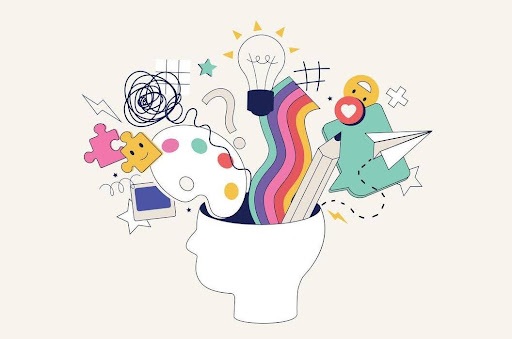
(https://fr.vecteezy.com/veteu...)
A key takeaway technique: The meta-prompt
Instead of spending twenty minutes trying to craft the perfect prompt, why not ask the AI to help build it? That is the essence of meta-prompting: before asking it to generate concepts, you instruct it to structure the best possible prompt to reach the desired outcome, forcing it to become more methodical and frame its reasoning.
The initial output doesn't need to be flawless either. An average concept might still contain a single word, mechanic, or angle worth keeping. You keep that "nugget," discard the rest, and iterate from there. Viewed this way, AI becomes far more compelling as a creative sparring partner than as an oracle expected to deliver a brilliant idea on the first try
More is not always better
In terms of ideas, at a certain point, you have to stop generating and start choosing. Among the methods explored during the workshop, the 3-shots method makes it possible to reflect on different levels of ideas. The sure shot banks on a simple, low-risk idea that directly meets the need. The favorite aims to create an emotionally strong idea and generate engagement, while the home run pushes reflection further with a bolder, technically more complex idea. The Impact-Effort matrix then allows you to quickly visualize the concepts that offer the best creative return and eliminate ideas that are too complex for little payoff.Ultimately, artificial intelligence does not change the basis of creative work. You still have to find the right problem, explore, make choices, and push the best paths forward. It simply gives us a new tool to do so and, when we know how to use it, a few new ways to break out of our own reflexes.

(www.istockphoto.com%2Ffr%2Fpho..." class="redactor-autoparser-object">https://www.istockphoto.com/fr...)


